
Why Artificial Turf Gets So Hot in the Sun — and What Cools It
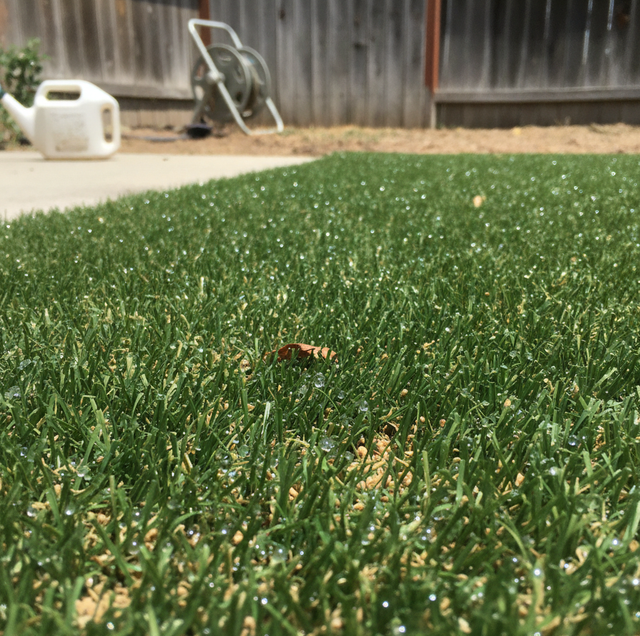
Artificial turf gets hot for a reason that has nothing to do with the product being cheap or poorly made. It comes down to two materials behaving exactly as physics says they will. The blades are a synthetic plastic, usually polyethylene and sometimes a stiffer nylon in high-traffic products, and plastic absorbs solar radiation the instant the sun lands on it. A deep green surface, designed to look like a real lawn, absorbs a large share of that light and converts it into heat. Real grass does the same thing. The difference is what happens next.
A living lawn cools itself. Roots pull moisture up through the plant, the blades release that water vapor through tiny pores, and the soil underneath evaporates its own moisture at the same time. That combined process, evapotranspiration, works like sweat on skin: every gram of water that evaporates carries heat away, which is why a watered lawn stays within a few degrees of the surrounding air even at midday. Synthetic turf has no roots, no water column, and nothing to evaporate. Once it absorbs heat, it has almost no way to shed it except slowly, by radiating it back to the sky and giving it up to any breeze that moves across the surface. So the heat piles up faster than it leaves, and the surface temperature climbs well past the air temperature.
Why the Surface Climbs Past Air Temperature
The number that surprises people is the gap between what the thermometer reads and what the turf reads. On a full-sun afternoon when the air sits around 100°F, independent surface-temperature measurements commonly put synthetic turf somewhere in the 140°F to 180°F range, depending on color, material, and how long the sun has been on it. That is not the turf generating heat. It is the turf that stores solar energy and cannot release it fast enough.
Two things set that ceiling. The first is absorption, governed by the surface's albedo, which is a measure of how much light it reflects rather than absorbs. A dark, matte green has a low albedo, so it takes in most of the light and reflects little. The second is the missing exit. With no evaporative cooling and no thermal mass to speak of, the thin plastic blades and the infill packed around them heat up quickly and stay hot as long as the sun is on them. The moment the sun drops behind a wall or a cloud, the temperature falls off quickly because there was never much mass to hold the heat in the first place. That is also why turf that felt scorching at 3 p.m. is comfortable an hour after sunset.
What Makes One Lawn Run Hotter Than Another
Not every synthetic lawn runs at the same temperature, and the differences trace back to a handful of drivers you can actually see.
Fiber color and material: Color is the biggest lever. A darker olive or forest blade absorbs more than a lighter lime or two-tone blade with tan thatch woven in. Material matters too. Nylon is a harder, more heat-tolerant structure, so it resists matting underweight, but it tends to feel hotter to the touch than the softer polyethylene used on most home lawns. Pile height and density play a quieter role: a tall, dense pile traps a cushion of hot air right at the blade tips where your foot lands.
Infill type and color: Infill is the granular material brushed down between the blades, and it holds a surprising share of the heat because it sits right at the contact surface. Silica sand is a pale tan and reflects more light, so it runs cooler. Crumb rubber, the recycled black granules used on many pet and sports installs, is close to the darkest surface you can put outdoors, and it absorbs and stores heat aggressively. Two identical lawns can differ by a real margin based solely on whether the infill is light sand or black rubber.
Sun exposure and duration: Heat is cumulative. A patch that bakes in direct sun from mid-morning on will run far hotter than a strip that catches only a few hours, and a lawn with a west-facing wall throwing reflected light onto it can run hotter still. The longer the exposure, the closer the surface creeps toward that upper range.
Dust and soiling: This is the driver most homeowners never think about. Fine dust, pollen, and organic film settle into the pile and onto the infill, and as that layer builds, it darkens the whole surface and drops its albedo. A gray, dust-caked lawn absorbs more light than the same lawn did when its infill was clean and pale. Packed dust and compacted infill also choke the drainage, so when you do rinse the turf to cool it, the water sheds and evaporates from a clogged surface faster and does less good. A neglected lawn works against you twice.
What Actually Brings the Temperature Down
You cannot repeal the physics, but you can shave real degrees off the surface and, more usefully, control how long it stays cool. Here is what works and what to expect from each move.
A rinse is the fastest fix. Wetting the blades and infill gives the surface something to evaporate on, which is the cooling channel that synthetic turf normally lacks. A thorough spray can pull the surface temperature down sharply within a minute or two. The catch is duration. Because turf drains and dries quickly by design, the cooling typically lasts on the order of 20 to 30 minutes in peak sun before the surface reheats, longer in shade or under cloud cover. A rinse before the yard gets used, rather than hours ahead, is how you get the benefit when you want it.
Lighter or cooling infill is the durable fix. Swapping a black crumb-rubber top layer for pale silica sand, or topping off with a manufacturer's cooling infill, changes the surface you actually contact. Some cooling infills are acrylic-coated sands designed to reflect more light; others, such as zeolite-based granules, are marketed to hold moisture and release it as slow evaporative cooling after a rinse or dew. Treat those performance figures as the manufacturer's claims rather than settled numbers, but the direction is sound: a lighter, more reflective infill runs cooler than black rubber.
Shade is the most reliable lever of all. A sail shade, pergola, or well-placed tree that keeps direct sun off the turf during the hottest hours prevents the heat from ever building, which beats trying to cool it after the fact. Even partial afternoon shade on a west exposure makes a measurable difference.
Keeping the surface clean helps in a small but real way. A lawn whose infill has been extracted and refreshed sits lighter in color than a dust-caked one, so it absorbs a bit less to begin with, and clean, decompacted infill lets a cooling rinse soak in and drain properly instead of sheeting off a clogged mat. A professional cleaning that power-brooms the pile, extracts embedded grit, and re-levels the infill restores the surface closer to how it behaved when it was new.
| Move | What it does | How long it lasts |
|---|---|---|
| Rinse with water | Adds evaporative cooling, the turf normally lacks | About 20-30 minutes in peak sun, longer in shade |
| Lighter or cooling infill | Raises reflectivity and can hold rinse moisture | Persistent once installed |
| Shade (sail, pergola, tree) | Stops heat from building up at all | Whenever the shade is over the turf |
| Deep clean and infill refresh | Lightens a dust-darkened surface, restores drainage | Between cleanings, typically several weeks |
Putting It Together
The heat is not a defect in your lawn; it is the price of a surface that looks like grass without being alive. Because it cannot sweat, synthetic turf stores what the sun gives it and releases it slowly, which is why a dark blade and black infill under long sun exposure can read well above the air temperature. The levers that help are the ones that either add the missing evaporation, reflect more light before it turns to heat, or block the sun outright. A clean, well-drained surface with lighter infill and a quick rinse before use will not feel cold on the worst afternoons, but it will run cooler than a dust-caked lawn left to bake, and it will recover faster once the sun moves off it.
Frequently Asked Questions
Right before use, every time. A rinse cools by evaporation, and in peak sun, that cooling is largely spent within about half an hour, so water put down on a timer at noon is gone by the time anyone steps out at one. Tie the rinse to the moment of use rather than the clock. A second rinse, a few minutes after the first, also buys much less than the first did: the pile and the top of the infill are already wet and have little capacity left to take on, and the big temperature drop comes from that initial wetting of a dry, hot surface. One good soak just before the yard is used beats several scheduled passes through the day.
It often can. Fiber color and material set a baseline, but the infill sits at the exact plane a foot or a paw touches, so a black crumb-rubber fill can push the contact temperature higher than a darker blade would on its own, and swapping that rubber for a pale sand can pull it back down further than a fiber change would. Put plainly, a cooler polyethylene blade laid over black rubber can still read hot, while a warmer nylon blade over light sand may touch cooler. If you can change only one thing on an existing lawn, the infill is usually the bigger-impact move, because it can be top-dressed during a cleaning without replacing the turf.
Realistically, no mitigation makes a full-sun surface feel cool at the peak of the day; it makes it less punishing. Paw pads and bare skin can burn on surfaces above roughly 125°F, so use the back-of-hand test: if you cannot hold your hand flat on the turf for seven seconds, it is too hot for paws. Rinse just before use, add shade over a pet's usual path, and walk dogs on the turf in the morning or evening when the surface has given up its heat.
While the sun is on it, turf runs hotter than a watered natural lawn and can rival dark pavement, but once the sun moves off it cools faster than concrete. Turf has very little thermal mass, so it dissipates heat quickly and is usually comfortable within an hour of sunset, whereas a thick concrete slab continues radiating stored heat well into the evening. A natural lawn stays coolest throughout because it never stopped evaporating.
Schedule a deep clean and infill refresh — extracting packed dust and re-leveling the infill helps a heat-soaked lawn drain and shed heat the way it was built to. TurfWash serves Phoenix and the surrounding metro, from Scottsdale and Mesa to Gilbert, Chandler, Glendale, and Surprise. Call (602) 300-7559.
