
Does Disinfectant Spray on Turf Kill Bacteria? Why It Misses
Grab a bottle of disinfectant, mist it back and forth across the turf, and the job feels finished. The label says it kills bacteria and viruses, the surface smells clean for an hour, and the whole thing took two minutes. It looks like sanitizing. Most of the time, it barely qualifies as rinsing.
The problem is not the product. Plenty of disinfectants really do kill what their labels claim. The problem is that the bacteria actually live on a turf lawn, and they are nowhere near the tips of the blades where a spray lands. The uric acid salts from pet urine, the organic film, and the bacteria feeding on both settle at the base, in the infill, an inch or more below the green fibers you can see. A mist that beads on the blade tops and dries in the sun never gets to them. To understand why spraying disappoints, it helps to follow the spray down, or rather to see how little of it goes down at all.
Why a Surface Spray Never Reaches Them
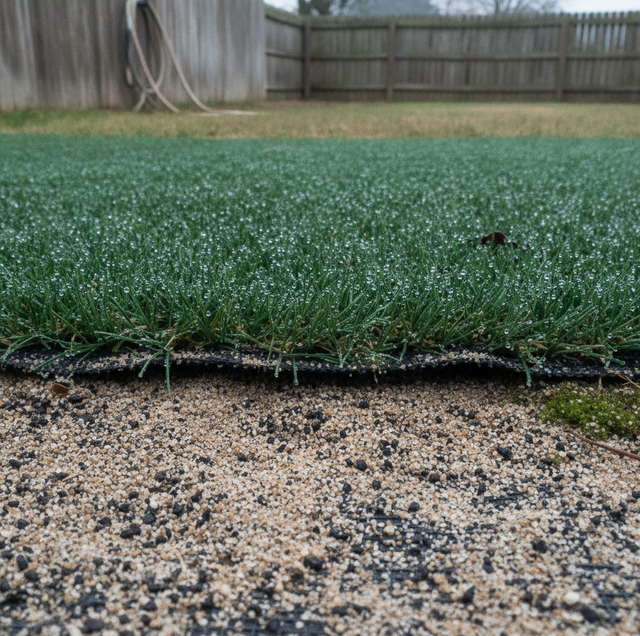
Look at turf as two layers. The top layer is the blades, the plastic fibers that give it the grass look. The bottom layer is the infill, the granular sand or coated sand, and sometimes crumb rubber that sits packed around the base of those fibers to weigh the turf down, hold it flat, and keep the blades standing. That infill is the part that matters here.
When a dog urinates, the liquid drains through the blades and soaks into the infill and the backing. Water evaporates in the dry heat, but the dissolved solids do not. Dog urine leaves uric-acid salts and urates behind as it ages, and these form sticky, hard-to-dissolve deposits that cling to the infill grains and the turf backing. Bacteria colonize that layer because it holds moisture, organic residue, and warmth, and their activity is what converts urea into the ammonia you smell. The infill, in other words, is both the food source and the housing. The blades are just the fibers that the whole mess passes through on the way down.
A surface spray is aimed at the wrong layer. It wets the fibers, maybe the top few grains of infill, and stops. The reservoir of bacteria and uric-acid crystals sitting at the base is not reached, not wetted, and not killed. You can repeat the spray every week, and the colony below keeps feeding on the same trapped residue, which is why the smell always comes back, and comes back hardest the moment the infill gets wet again and releases what has been building down there.
Contact Time Is the Whole Game
Here is the part almost no one reads: the kill claim on a disinfectant label comes with a contact time, also called dwell time. That number is the amount of time the surface must remain visibly wet with the product to achieve the advertised result. Depending on the chemistry, it can run several minutes, and some organisms on the label need the longer end of that range. Wipe or let it dry before the clock runs out, and you did not disinfect. You cleaned lightly.
Now picture that requirement on a turf lawn. The disinfectant hits vertical plastic fibers under the open sky. Gravity pulls most of it straight down and off the blade. The dry, warm air and hot infill evaporate what is left in a fraction of the time the label demands. Even in cooler months, thin liquid on an exposed surface flashes off fast. You would have to keep the entire lawn continuously wet with product for the full contact time to get anywhere close to the label kill, and a hand sprayer misting the top does the opposite. It lays down a thin film that is gone in seconds.
So the failure is not only that the spray lands on the wrong layer. Even the fraction that lands where bacteria live evaporates or drains before it has been in contact long enough to work. Penetration and contact time are the two things that make a disinfectant do its job, and a hose-and-spray delivers neither.
The Organic Load That Cancels the Chemical
There is a third strike, and it is the one people least expect. The very filth you are trying to sanitize can neutralize the disinfectant before it kills anything.
Many household and pet-area disinfectants are built on quaternary ammonium compounds, the class often shortened to quats. Quats are known to be inactivated by heavy organic soil. Urine, feces residue, and the biofilm bacteria all count as organic load, and when a quat binds to that gunk, it is used up on the debris instead of on live bacteria. Hard tap water works against them too, because the calcium and magnesium in hard tap water can tie up quat molecules and cut their strength, and mixing concentrate with that same hard water only starts you off weaker. Oxidizing cleaners such as hydrogen peroxide or sodium percarbonate face a related trap: they burn themselves out reacting with the pile of organic residue and have less left over for the bacteria.
This is why disinfectant instructions for real-world messes tell you to clean the surface first, then apply the product to an already-cleaned surface for the contact time. On turf, the surface is never pre-cleaned. You are spraying disinfectant directly onto a bed of concentrated organic waste in the infill, which is close to the worst case for the chemistry. A large share of the product is spent the instant it touches the load, and there is no rinse or extraction to carry the neutralized mess away afterward.
Spray-On Versus Deep-Clean, Side by Side
The contrast is easiest to see laid out plainly.
| Surface disinfectant spray | Extraction deep-clean | |
|---|---|---|
| Where it acts | Blade tips and the very top of the infill | Down into the infill where waste is bound |
| Contact time | Evaporates or drains before the label time | The product is worked in and given dwell to act |
| Organic load | Neutralized by urine salts and biofilm on contact | Broken up first, then the residue is removed |
| The waste itself | Uric-acid crystals stay in place | Dissolved and physically extracted |
| Result | Smell returns when infill gets wet | The reservoir is gone, not just masked |
The line that matters is the last one. A spray, at its absolute best, kills some surface bacteria and leaves every bit of the uric-acid salt, dead cell debris, and organic film exactly where it was. That residue is food. It re-colonizes. Removing the reservoir, not just misting over it, is the only thing that changes the outcome for more than a few hours.
What It Takes to Reach the Infill
Actually treating turf means getting a cleaning solution down to the base, keeping it in contact long enough to work, and then pulling the loosened waste back out. That is a different operation from spraying, and it usually runs in stages.
First, the infill gets decompacted, often with a power broom, so it is loosened and open rather than packed tight, which lets the solution travel down instead of beading on top. Then the treatment is applied in enough volume to penetrate and work into the base, not misted over the tips. Enzymatic and bio-based cleaners belong to this step. They use live cultures and enzymes that digest uric acid crystals over time, so they need to be driven down into the infill and given real dwell time to do their work, which is the exact opposite of a quick surface fog. A power wash breaks up hardened deposits that a garden hose cannot move.
The stage that separates real cleaning from spraying is extraction. Machine extraction physically pulls dissolved urine salts, the loosened organic film, and the killed bacteria up and out of the infill, so the food source leaves with the water instead of drying back in place. That is the difference between neutralizing the odor for an afternoon and removing the source of it. A spray can, by design, only adds liquid. It has no way to remove anything, and removal is the whole point.
Frequently Asked Questions
No, and it can create new ones. Concentration was never the limiting factor; penetration and contact time are, so a stronger mist on the blade tops still fails to reach the infill. Overusing harsh products has its own downside: bleach and some acids can discolor blades, weaken the backing seams, and leave residue around pets. The turf backing and infill are not designed to be soaked in caustics, and a higher dose does not buy you the one thing you need, which is getting the product down to the base and then out again.
Vinegar is a mild acid that can cut some fresh surface odor and is often suggested as a rinse, but it is not a registered disinfectant and does little against bound uric acid crystals deep in the infill. It also does nothing to remove the waste, so like any spray, it treats the top and leaves the reservoir. If anything, a light vinegar rinse only masks the smell briefly rather than addressing the bacteria and salts causing it.
Because a disinfectant is built to kill living cells, not to digest waste, and the odor is not coming from the cells. It comes from insoluble uric-acid salts and urates lodged in the infill, and those are stable deposits that a disinfectant has no mechanism to break apart. Only enzymatic cleaners actually digest urates into lighter substances that gas off; killing bacteria sitting on top of the deposit does nothing to the smell source. The deeper the deposit sits in the infill, the faster the odor returns once it is wet, because the packed lower layer stays damp longer and re-releases ammonia whenever moisture reaches it.
No, and that gap is part of why turf defeats them. Required dwell time varies by chemistry: a quat-based product and a hydrogen peroxide one list different wet-contact windows for the same organism, and each of those windows is validated on hard, non-porous surfaces such as sealed floors or counters. Porous, soiled infill is not on that list. No label establishes a contact time for wet sand packed with organic waste, so even a product kept perfectly wet has no tested kill time for the surface you are actually treating. That missing baseline, not just fast evaporation, is why label numbers never transfer to a lawn.
Antimicrobial-coated infill, such as some coated-sand products, is designed to slow bacterial growth and help with odor, and manufacturers make claims to that effect, but it is a slowdown, not a self-cleaning system. Waste, uric acid salts, hair, and dust still accumulate on and around the grains and need to be physically removed. Treat an antimicrobial infill as one helpful layer, not a reason to skip extraction, especially in a heavy pet area.
For an active pet lawn, cleaning every four to six weeks keeps uric acid salts and bacteria from building up to the point where odor becomes strong, with heavier-use yards leaning toward the shorter end. Between professional visits, a bio-enzyme product, when worked into the infill and given time to dwell, helps hold odor down, but it supplements extraction rather than replacing it. Rinsing after use dilutes fresh urine, yet without periodic extraction, the salts still concentrate in the infill over the weeks.
Why the Bottle Never Wins
A disinfectant spray fails on turf for reasons unrelated to how good the product is. It lands on the blades while the bacteria and uric-acid salts live down in the infill. It evaporates and drains long before it meets the contact time its own label requires. And it gets neutralized on contact by the organic waste it was supposed to kill, with no rinse or extraction to carry any of it away. Sanitizing that lasts is not about finding a stronger spray. It is about penetration, real dwell time, and physically pulling the waste out of the infill, so the food source leaves instead of drying back in for the next colony.
If your turf still smells after every spray-down, have the infill deep-cleaned and the waste extracted, not just misted over. TurfWash serves Phoenix and the surrounding metro, from Scottsdale and Mesa to Gilbert, Chandler, Glendale, and Surprise. Call (602) 560-8582.
