
Antimicrobial Infill Still Smells? What It Can't Remove
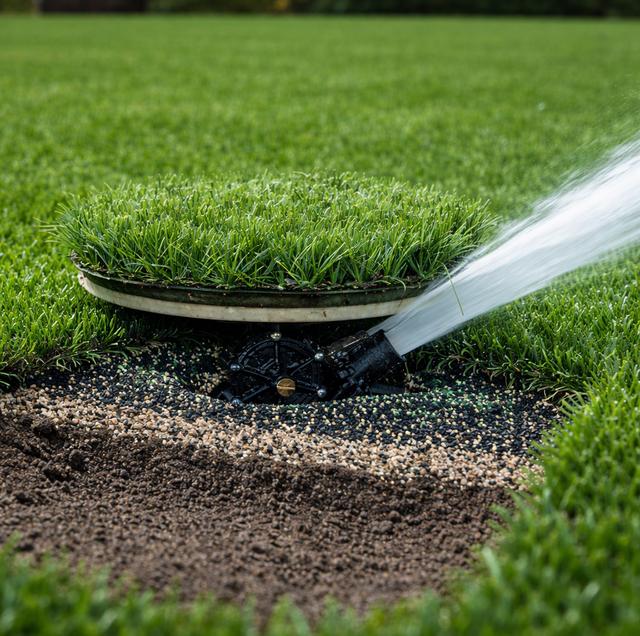
Antimicrobial infill gets sold on a tidy promise: build the odor protection into the turf itself and the smell problem mostly takes care of itself. The grains are treated to fight bacteria, so the reasoning goes, so a lawn filled with them should stay fresh on its own. Then a year or two in, the same sour ammonia note is back on a warm afternoon, strongest right after the turf gets wet, and the coating that was supposed to prevent it is still down there doing whatever it does. The infill did not exactly fail. It was only ever built for a narrower job than the label led you to expect.
The gap between what antimicrobial infill promises and what turns up in the yard comes down to one distinction the marketing tends to blur. Slowing the bacteria that cause odor is a different job from removing the waste that odor comes from. Follow what the coating actually touches, and the reason the smell returns stops being a mystery.
What Antimicrobial Infill Is Built to Do
Infill is the granular layer packed around the base of the plastic fibers to weigh the turf down, hold it flat, and keep the blades standing. Usually it is silica sand, sometimes coated sand, and sometimes crumb rubber. The antimicrobial versions are that same granular layer with something added to the grain, and two broad approaches often get lumped together under one label.
The first is an antimicrobial coating, frequently a silver-based agent or a branded additive bonded to the surface of coated sand. Its job is to inhibit bacteria from growing on the grain it covers. The second is a mineral like zeolite, a porous volcanic material chosen not to kill anything but to trap ammonia. Zeolite works by cation exchange: its pore structure holds ammonia molecules so the smell is adsorbed into the grain instead of released into the air.
Both are real tools with a real, narrow effect. A coating means fewer odor-producing bacteria multiplying on the treated grains. A zeolite means some ammonia is held rather than let go, at least while it is new. What neither one is, is a cleaning system. That is the whole misunderstanding, and everything else follows from it.
Suppressing Bacteria Is Not Removing the Deposit
To see the limit, separate the two jobs the treated grain is doing. A coating suppresses bacteria and a zeolite adsorbs ammonia by cation exchange, but the odor's raw material is the deposit dog urine leaves behind: uric-acid salts and urates that dry onto the infill and backing and shrug off plain water, with an organic film settling over them. Neither mechanism touches that deposit at all.
Here is where the promise and the mechanism part ways. An antimicrobial coating acts on living bacteria. Uric-acid salts and urates are not alive. They are chemical deposits, and a coating designed to suppress microbial growth has no way to dissolve them, digest them, or carry them off the property. Even if it held bacterial counts down perfectly for years, the salt reservoir would keep stacking up grain by grain, accident by accident, entirely untouched by the thing meant to protect the lawn.
Zeolite runs into a related wall. Its ammonia-holding capacity is finite, with a fixed number of exchange sites, and heavy pet use fills them. Turf with zeolite often smells fine when new and then turns as the pores saturate, because once the sites are full, the mineral stops taking up ammonia. It also does nothing about the solid urate crust feeding the smell in the first place. Suppression and adsorption both buy time. Neither empties the reservoir, and the reservoir is what the odor comes from.
Why the Coating Fades With Use
Even the part that does work does not stay at full strength. An antimicrobial coating is a thin surface treatment on each grain, and thin surface treatments wear. Foot traffic and pet traffic grind the grains against one another. Power brooming, the tool used to decompact packed infill, rubs them harder still. Constant heat and intense sun degrade many coatings over months, and while summer is the peak, the daily cycle of heating and cooling stresses the grains the rest of the year too, so wear is a year-round load rather than a single-season event.
Burial is the quieter problem. An antimicrobial coating works by contact, and contact is exactly what it loses. As the organic film, dried urine residue, dust, and biofilm build up, each grain gets wrapped in a layer of gunk. New bacteria then settle on that coating of waste rather than on the treated surface underneath. The additive is still present, still technically there in the infill, but no longer touching what it was put there to fight. Fine grit settling out of dry air adds to the burial and packs the layer tighter, which slows drainage and keeps the root zone damp longer.
So the protection that is strongest the day the infill goes in tapers as the grains abrade, bury, and compact, while the deposit it was never able to remove keeps growing underneath the whole time.
Why Moisture Brings the Smell Back
Uric-acid salts are stubborn when dry, but they are not permanent solids. They rehydrate. When the infill gets wet, from irrigation, a rinse, or a rain, the dried deposit dissolves and releases ammonia, and it does that most strongly at the moment it wets. Because infrequent rain rarely flushes a lawn thoroughly, the salts tend to concentrate in the infill over weeks and then let go hardest whenever moisture finally reaches the saturated lower layer. Dogs using the yard in every season keep feeding the deposit, so there is no cold stretch where it pauses.
Whatever bacteria the coating did not stop, and some always establish in the buried film, now have moisture, warmth, and a steady food supply, and their activity converts urea into the ammonia your nose reads as dog urine. A packed, saturated infill also goes short on oxygen, which is where the harsher ammonia and sulfur notes come from. That is the mechanism behind the pattern owners describe most often: the lawn smells worst right after it gets wet. The antimicrobial layer never removed the salts, and water is simply the trigger that wakes them up.
Reading the Claims Fairly
The numbers on antimicrobial products deserve a clear-eyed read. Figures like a 99.9 percent kill rate, hundreds of billions of micro-organisms per gallon in a companion treatment, or a long list of named pathogens are the manufacturers' own stated results, generated under their own test conditions. They are claims, not settled science, and certainly not a guarantee about a specific backyard after a year of dog traffic, abrasion, and burial. Treat them that way.
None of that makes antimicrobial infill worthless. Slowing bacterial growth is a real if modest help, and a zeolite's ammonia adsorption does reduce odor while its pores have room. The fair conclusion is narrower than the sales pitch: antimicrobial infill is one layer of odor management, useful mainly for stretching the interval between deep cleans, not a replacement for cleaning. What it cannot do, by design, is take the accumulated waste out of the yard.
Removing the deposit is a physical job with steps a coating cannot perform. The infill is decompacted, usually with a power broom, so treatment travels down instead of beading on top. An enzymatic or bio-enzyme cleaner is then driven into the loosened infill and given real dwell time to digest the uric-acid crystals, since enzymes only act on what they contact. Some providers run an anti-bacterial pre-soak first, and the high kill percentages quoted for that step are again the company's figures rather than proof. The step that ends the cycle is machine extraction: a wet-vacuum pass that draws the dissolved salts, spent cell debris, pet hair, and organic sludge out through the infill and off the lawn. Once the reservoir leaves the property, there is nothing for the next wetting to reactivate, and nothing for a fresh coating to sit uselessly on top of.
What the Infill Can and Can't Carry
Buying antimicrobial infill is buying a slower build, not a sealed one. The head start erodes as the grains wear and bury, while the salt deposit the coating can never touch keeps accumulating below. Judged by that reality, a treated lawn that smells again after a wet morning is not a defect. The coating reached the edge of what suppression can do, and the deposit underneath is waiting to be pulled out. A regular cleaning interval, with the waste extracted rather than masked, is what empties the reservoir the antimicrobial layer was never designed to remove.
Frequently Asked Questions
Yes, within limits. Its edge is largest when the waste load is light, and the infill is still new and open: a low-traffic putting green or a pet-free play area holds its benefit far longer than a dog run. Its edge is smallest exactly where people hope it will save them, in a heavy pet zone where one dog keeps hitting the same patch and rebuilds a dense salt deposit faster than any coating can matter. Many premium infills pair a silver-type coating with zeolite to get both suppression and ammonia adsorption at once, a stronger starting point, but both still saturate and wear on the same timeline.
There is no honest universal number, and some products are marketed with "lifetime" protection language that should be read as a claim, not a spec. In practice, effectiveness drops as the grains abrade and get buried, and in a heavy pet yard that can be within a year or two rather than the life of the turf. There is a twist worth flagging: power brooming, the same step that decompacts the infill so it drains and cleans properly, also grinds the grains and can thin the coating. That does not mean skip brooming, since compacted infill smells worse; it means the coating is a wearing surface, not a permanent seal.
Neither substitutes for removal. A topical antimicrobial or deodorizing spray sits on top, needs contact time, rarely gets on hot open turf, gets partly used up by the organic waste it lands on, and none of that dissolves the salts already bound in the infill. Topping up with fresh coated grains is worse as a fix, because it lays clean infill over an unremoved deposit and buries the smell source deeper instead of taking it out. Infill top-up has a real place, but it belongs after extraction, to refill a lawn that was under-filled, not instead of cleaning one that smells.
It does get used up. Zeolite adsorbs ammonia through a finite set of exchange sites, and heavy urine saturates them, at which point it stops holding new ammonia and can begin releasing what it stored when wetted. Zeolite can be partially regenerated by flushing it with clean water, which reverses some of the ion exchange, but a yard rarely receives the thorough, repeated flushing needed to reset it, and where rain is infrequent, natural flushing rarely happens. Just as important, flushing does nothing to the solid urate crust and organic film that a saturated zeolite is sitting in, so recharging the mineral is not the same as cleaning the lawn.
Be cautious here, because this is where overreliance does the most harm. An antimicrobial coating is aimed at slowing odor-causing bacteria on the treated grains, and the kill claims tied to these products are manufacturer figures, not a medical guarantee. Pet waste can still deposit organisms into the infill regardless of the coating, especially once the grains are buried in film, and the additive is no longer in contact. The safe way to read it is that antimicrobial infill may help with odor, not that it sanitizes the yard. Reducing the bacterial load comes from physically removing the waste through pre-soak and extraction, not from trusting the grain coating to handle it.
Only if the old deposit is dealt with first. Turf that has taken years of pet use holds urate salts and organic residue not just in the infill but pressed against the perforated backing and the lower grains, and swapping the loose infill on top can leave that bound residue behind to keep the smell going. For most lawns, a staged deep clean with extraction clears the odor without pulling anything up. Full infill removal and replacement earns its place only in narrow cases: a lawn that never held enough infill to begin with, crumb rubber that has crumbled toward powder, or a coating so buried and a crust so set that extraction cannot lift it. Laying fresh antimicrobial infill over an uncleaned base just restarts the same cycle with a newer coating.
If your antimicrobial infill has started to smell again, have the infill deep-cleaned and the waste extracted rather than masked or topped over. TurfWash serves Phoenix and the surrounding metro, from Scottsdale and Mesa to Gilbert, Chandler, Glendale, and Surprise. Call (602) 560-8582.
