
Can Old Artificial Turf Be Restored, or Is It Done?
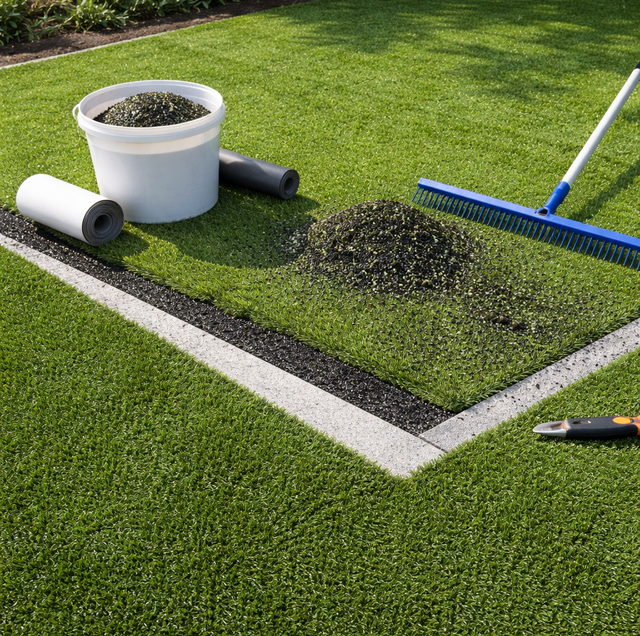
Every synthetic lawn eventually gets old, and every owner of an aging one arrives at the same fork: is this turf worth restoring, or is replacement the only honest answer? It is a fair question and an easy one to guess wrong. The yard that looks finished from the patio is sometimes only dirty and packed down, while the yard that still looks passable underfoot can be failing in the one layer you never see. Age alone does not decide it. What decides it is which part has actually worn out.
So before you write off a lawn or pour effort into reviving one, it helps to sort the problems into two piles. One pile is serviceable. The other is structural, and no amount of cleaning or grooming brings it back.
The Real Dividing Line Runs Below the Blades
A turf lawn is really two things stacked together. On top is the face: the polyethylene or nylon fibers tufted into a backing, standing in a bed of infill. Below that is the foundation: the primary backing that anchors the tufts, the secondary coat that locks them in, the perforated drainage holes, and the compacted aggregate base underneath. Almost every restore-or-replace question comes down to which of those two layers is in trouble.
Face problems are serviceable. Blades matted from traffic, color gone dull under the sun, infill walked into a hard crust or thinned out of the busy lanes, dirt and pet waste embedded near the base, a seam edge that has lifted, a small burn or tear: all of that lives at or near the surface, and all of it can be cleaned, re-groomed, re-filled, or spot-repaired. The fibers themselves are still intact; they are just buried, bent, or starved of support.
Foundation problems are terminal. When the fibers have been split and shredded by ultraviolet light, when the backing has grown brittle, and cracks or the tufts pull loose, when the pile has been ground down to bare backing across whole areas, or when the base below has slumped so water no longer drains, cleaning does nothing, because there is no healthy material left to restore. Telling those two piles apart is the whole job, and you can usually do it by hand before anyone quotes you anything.
Restore or Replace, Issue by Issue
Most aging lawns show several of these at once. Read each row for the problem you actually have, not the worst one you can imagine.
| What you are seeing | Can it be restored? | What it takes, or when replacement wins |
|---|---|---|
| Matted, flattened traffic lanes | Usually yes | Decompaction and grooming stand pliable blades back up; replacement only if the fiber itself is brittle and split |
| Faded, dull color from sun | Partly | A deep clean removes the dust and mineral haze that reads as fading; true UV-bleached, chalky fiber does not re-color and is a sign of deeper wear |
| Seam edges lifting or separating | Often yes | Re-nailing edges and re-bonding with fresh seam tape and adhesive; replace only if the backing around the seam has crumbled |
| Infill thinned out or packed hard | Yes | Power-broom to decompact, then redistribute and top up silica sand or crumb rubber to depth |
| Water pooling, slow drainage | Depends | If infill is clogged, decompaction reopens it; if the perforated backing is torn or the base has compacted, that is structural |
| Small tears, cuts, or a barbecue burn | Yes | Cut out the spot and patch it with a matched offcut; localized, not a whole-lawn issue |
| Widespread bald spots, fibers shedding | No | The face weight is spent; grooming has nothing left to lift, and re-lay is the honest call |
| Backing brittle, cracking, tufts pulling free | No | The anchor layer has failed; the pile cannot be re-secured to a backing that is disintegrating |
The top rows share a root cause you can undo. The bottom rows do not. The single most common mistake is treating a bottom-row lawn like a top-row one: cleaning and grooming turf whose fibers and backing are already gone, then wondering why it looks no better a month later.
What a Real Restoration Actually Involves
Restoration is not one service; it is a sequence, and each stage rescues a different part of the face. On a lawn whose foundation is sound, the difference between tired and nearly new is mostly a matter of doing all of these rather than one.
Deep clean and sanitize: the base layer of any revival. A power wash lifts dried pet waste, packed dust, and the hardened spots a garden hose skates over, and an extraction step pulls dissolved salts, pet hair, and organic sludge up and out of the infill instead of pushing them deeper. Providers that sanitize also run an anti-bacterial pre-soak; the high kill percentages quoted for those products are the companies' own stated figures, so read them as claims rather than settled science. What matters for a restoration is that the embedded grit and waste that dull the blades physically leave the yard.
Decompact and refluff: a power broom, a motor-driven vertical brush, digs into the crusted infill a hand rake only scratches, reopens the drainage path through the backing, and lifts blades that had been pressed into a flat mat. This is also the step that reverses much of what looks like fading, since a surprising amount of dullness is just dust and mineral scale sitting on the fiber.
Re-infill: infill migrates, walks out of the lanes and into the corners over the years, and a lane that has lost its sand has lost the scaffolding that holds the lower third of each blade upright. Leveling the remaining infill and topping it back up, typically toward the range of one to two pounds per square foot depending on pile height, restores that support and helps the pile stand and drain.
Re-seam and edge repair: where two rolls meet, the bond is seam tape and adhesive beneath the backing, and edges are held with nails or staples. A lifted seam or a popped edge is repairable on its own: re-nail the perimeter, tuck and re-bond the seam, pull any exposed fasteners. You do not replace a lawn because one seam let go.
Spot repair: a tear, a cut, or a melt spot from a grill or a reflected sunbeam is a local problem with a local fix. The damaged section is cut out, and a patch from a matched offcut is seamed in. The catch worth knowing up front is color: a fresh patch rarely matches sun-faded turf exactly, because the new piece and the old one weather differently, so a patch in the middle of an old lawn tends to show.
When Replacement Is the Honest Call
There is a point where restoration stops being a fair recommendation, and a straight answer saves you from replacing a lawn that could have been restored. Replacement is the right call when the failure is in the material itself rather than on top of it.
The clearest signal is the fiber. Years of strong sun slowly break down the polymer in the blades, and degraded fiber loses its flexibility before it loses all its color. Fold a blade between two fingers: if it cracks, crazes, or splits into loose fringe instead of bending and rising, ultraviolet light has spent it, and no grooming rebuilds a fiber that snaps. When that brittleness is everywhere, not just in one lane, the face is finished.
The second signal is the backing. When the primary and secondary backing grow brittle with age, tufts start to shed, seams refuse to hold because there is nothing solid to bond to, and the sheet can ripple or ruck. A pile that pulls out in your fingers is not a cleaning problem. The third is coverage: once bald, worn-through spots are widespread rather than isolated, the face weight, the ounces of yarn per square yard the turf started with, has simply been ground away. A common rule of thumb in the trade is that when damage is scattered across more than roughly fifteen to twenty percent of the surface, patching stops making sense and re-laying the area is the sounder move. And when water pools long after a rain or a rinse and decompaction does not fix it, the trouble is the torn drainage backing or a slumped base, which a top-side service cannot reach.
When two or three of those show up together in the same yard- brittle blades, a failing backing, widespread bald patches- that lawn has reached the end of its service life, and restoration would only buy a few more months out of a lawn that is already failing.
Reading Your Own Yard Before Anyone Quotes You
Start on your knees in the worst area, not with a phone call. Rub the blades against the grain and fold a few over. If they flop and rise and feel soft, the face is alive and probably just needs cleaning, decompaction, and infill. Press the infill: if it is hard as a crust, that is reversible. Check a seam and an edge: a lift is a repair, not a verdict. Then look for the disqualifiers: brittle cracking fiber, tufts that shed into your hand, bald backing, and standing water that will not drain. Most real lawns land in the middle: living, recoverable turf across the open areas, with one or two hammered zones that may need patching or re-laying on their own. Sorting the serviceable face from the failed foundation, area by area, is what turns a vague dread about the whole lawn into a specific, solvable job, and it is the difference between a restoration that lasts and a replacement you actually needed.
Frequently Asked Questions
There is no fixed number, because use matters more than age. Manufacturers often cite service lives in the range of fifteen to twenty-plus years, but those are marketing figures for light, well-maintained turf, and a heavily used pet yard under constant sun can wear its fibers out well short of that while a shaded, lightly walked lawn can outlast it. The better gauge is the bend test, not the calendar: as long as the fibers still flex and rise and the backing holds its tufts, restoration keeps working regardless of the install date.
Partly, and it is worth knowing which part. A large share of what owners read as fading is not lost color at all; it is a haze of dust, dried mineral scale from hard water, and embedded grit sitting on the blades, and a proper wash and decompaction lifts that off and brings back a good deal of the green. What does not come back is true UV bleaching, where the pigment in the polymer itself has broken down, and the fiber has gone chalky and pale through its whole thickness. A clean tells you which you have: if color returns, it was dirt; if it stays washed-out and the fiber feels brittle, the fading is structural.
It is cosmetic, not structural, but plan for it. New turf and years-old turf rarely match, partly because they weather differently and partly because a fresh piece often comes from a different production run, or dye lot, than the original. On a small tear in an out-of-the-way spot, that is a fair trade for a durable fix. In the middle of a visible lawn, a patch can stand out enough that re-laying the whole section looks better even when a patch would function fine, which is one reason widespread damage tips toward replacement rather than a quilt of mismatched repairs.
Only if the slow drainage is coming from the infill, which it often is. Foot and pet traffic packs infill into a crust, and fine dust clogs the top layer, and both throttle the perforated backing's ability to move water; a power-broom decompaction reopens that path and usually restores flow. What restoration cannot fix is drainage failing below the turf: a torn drainage backing, or a compacted or settled aggregate base that no longer carries water away. A quick test is to decompact and rinse; if water still pools afterward, the trouble is structural and sits under the turf, not in it.
Rarely. Synthetic fibers do not rot from urine the way natural grass dies, so even a yard used hard by dogs for years is usually a cleaning and extraction problem, not a replacement one; the odor and bacteria live in the infill and can be pulled out, and the infill topped up. Replacement only enters the picture when a dog has physically destroyed the face, chewed or dug through the backing, or worn a favorite corner down to bald backing, or when crumb-rubber infill has broken down and needs full removal rather than a top-up. The inspection is what separates a dirty pet yard, which restores, from a damaged one, which may not.
No, and you usually should not. Turf failure is often local: one pivot lane by the gate, the strip under a bench, the corner a dog owns. Those zones can be cut out and re-laid on their own while the healthy majority is cleaned, decompacted, and re-filled. What makes a section re-lay work is the seam: the failed piece is cut back to a straight line, and a fresh panel is joined to the sound turf with seam tape and adhesive run under the backing, the same bond used where two rolls met at install. That join is easiest to hide when the re-lay runs to an edge, because one side meets a border instead of aged turf and the eye reads a clean perimeter line rather than a color break. A patch dropped in the middle of the lawn has sun-weathered turf on all four sides, so any difference in sheen or dye lot shows from every angle, which is why an edge or full-strip re-lay usually looks cleaner than an island patch even when both would hold.
Not sure whether your aging lawn is dirty or truly worn out? Book a turf blade, infill, and life inspection to get a straight restore-or-replace read before you commit to either. TurfWash serves Phoenix and the surrounding metro, from Scottsdale and Mesa to Gilbert, Chandler, Glendale, and Surprise. Call (602) 560-8582.
