
Flattened Artificial Turf: Fixable or Time to Replace?
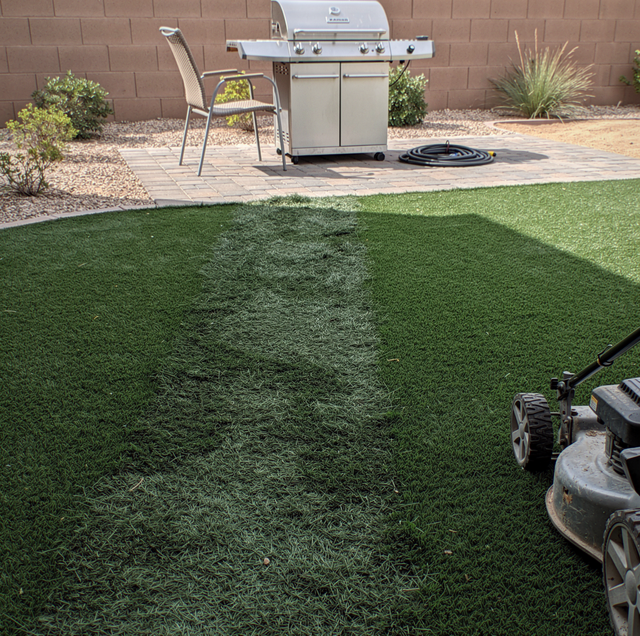
A flattened path across a lawn, worn in at the gate, the grill, or a dog's favorite corner, raises one question before anything else gets decided: is that section actually damaged, or just pressed down? The two look almost identical from a few feet away, but they call for completely different fixes, and guessing wrong means either replacing turf that had years left in it or spending money on maintenance that was never going to work.
Two Different Things Cause Matting, and Only One Is Reversible
Artificial turf blades are held upright partly by their manufactured shape and partly by the infill layer packed around their bases, which acts as a foundation, holding each blade upright. Foot traffic, pet activity, and furniture legs press that infill down over time, a process called compaction. Compacted infill loses the loft that used to support the blades, so the fibers lean over and stay leaning, because there's nothing underneath pushing them back upright.
This kind of matting is a mechanical problem, not a material one. The blades themselves are intact; they're just lying on top of infill that's been pressed too flat to hold them up. That's revivable, because the fix is restoring the infill's loft, not replacing anything.
The second cause is different: repeated bending, UV exposure, and years of traffic can break down the polymer structure of the blade itself, at the base where it meets the backing or partway up the fiber. Once a blade's internal fiber structure has fractured, no amount of brushing, fluffing, or infill work will make it stand up again, because the blade has lost the structural memory that used to snap it back after being stepped on. That's permanent, and it means the material has reached the end of its useful life in that spot.
How a Life Inspection Tells the Two Apart
A life inspection is a hands-on assessment of the turf's remaining condition, checking fiber flexibility, backing integrity, and infill depth section by section rather than judging the whole yard by its worst-looking corner. A technician will typically test a flattened area by working infill back into position and observing whether the blades respond, since fiber that's still structurally sound will spring back upright once it has support underneath it again. Fiber that's fractured or brittle stays flat regardless of how much infill support it gets, which is the clearest sign that section has aged out rather than just compacted.
Turf life varies enormously by use and installation quality. A section can show wear within a year or two under constant heavy dog traffic and full sun exposure, while a well-installed, moderately used lawn can hold up for fifteen years or more before fiber-level replacement becomes necessary. That range is part of why a spot inspection matters more than a blanket assumption based on the turf's age alone; a five-year-old lawn in a shaded, low-traffic yard can still have plenty of life left in its fibers even if one high-traffic path looks rough.
Compacted Infill vs. Fiber Damage
| Signal | Compacted infill (revivable) | Fiber damage (permanent) |
|---|---|---|
| How it responds to hand-fluffing | Blades lift and stand up with effort | Blades stay flat no matter how much you fluff them |
| Appearance under close inspection | Fiber looks intact, just pressed down | Fiber looks frayed, thin, or bent at a fixed crease |
| Drainage in that spot | Often slow, since compacted infill blocks the backing's perforations | Can drain normally if backing is undamaged |
| Where it usually shows up | Paths, gate areas, under furniture legs | Long-term full-sun zones, very old installations |
| What restores it | Power brooming to decompact and refluff | Section replacement; brooming won't reverse it |
| Timeline to notice | Weeks to months in a high-traffic spot | Gradual over years, or fast under extreme sustained heat and traffic together |
Why Power Brooming Works on the Revivable Kind
Power brooming uses a mechanized brush to break up compacted infill and lift blades back to their intended angle, working infill loose enough that it can redistribute and support the fiber base again rather than holding it flattened. This is a physical reset, not a surface treatment, which is why it can bring a badly matted path back to looking like the rest of the lawn in a single visit when the underlying fiber is still sound. It's also the same step that improves drainage in a compacted zone, since loosened infill allows water and rinse-down to pass through the backing's perforations rather than pooling on top.
Brooming does nothing for fiber that's already broken down at the structural level, which is exactly why a life inspection has to happen before the brooming pass, not after. Working infill under fiber that can't hold a shape anymore just wastes the effort and can mask a section that actually needs replacement, delaying a decision that an accurate read at the start would have settled immediately.
When Replacement Is the Right Call
If a life inspection shows fiber that stays flat after decompaction, splits or thins visibly under close inspection, or comes away from the backing when gently tugged, that section has reached the end of what maintenance can do for it. Installation and section replacement are handled by a separate sister install company rather than by the cleaning and maintenance side, so a life inspection serves as the diagnostic step that tells you which direction to go before committing to either path.
What Drives How Fast a Section Wears Out
Traffic pattern matters more than raw foot count. A single path walked daily in the exact same footprint wears faster than the same number of total steps spread across an open lawn, because the pressure lands on the same fibers over and over rather than being distributed across a wider area. That's why gate approaches, the stretch between a patio and a grill, and the perimeter of a pool deck tend to show matting years before the rest of an otherwise identical lawn.
Sun exposure compounds the effect. A section in full sun for most of the day breaks down fiber structure faster than a shaded section seeing the same amount of foot traffic, since UV exposure is what makes the polymer brittle at the base over time, not the traffic alone. A shaded path can handle years of regular use and still test as revivable, while a sun-baked path with lighter use can show real fiber damage sooner simply because it absorbs more direct radiation day after day.
Infill depth plays a role too. A section where infill has settled below its original depth gives blades less support to begin with, so the same traffic level compacts that thin spot faster than a section with proper depth maintained. This is one reason a life inspection checks infill depth alongside fiber condition rather than looking at the fiber alone; a path that looks matted might actually be a shallow-infill problem that a depth top-up solves without any fiber-level concern at all.
Why Guessing at Home Usually Gets This Wrong
It's tempting to judge a flattened section just by how it looks and feels underfoot, but sight and touch alone can mislead in both directions. A section that looks rough from ground-in dust and debris can still have fully intact fiber underneath, needing nothing more than a cleaning and a brooming pass. Meanwhile, a section that looks fine at a glance, especially in low light or from a distance, can have fiber that's already lost its structural spring, something that only shows up once you actually work the infill and watch how the blades respond.
That's the practical reason a life inspection is a hands-on, section-by-section process rather than a single yard-wide verdict. Two paths that look equally matted from the porch can turn out to need two completely different fixes once someone actually tests them, one a quick decompaction visit, the other a conversation about section replacement.
Frequently Asked Questions
It depends on traffic. A path used daily by people or a dog can start showing compaction again within a couple of months, while a lower-traffic section can hold its loft for close to the full recommended four-to-six-week cleaning interval before it needs another pass.
Not much on its own. Fresh infill poured over a compacted base tends to settle into the same packed structure underneath it fairly quickly, since the compaction problem is in the existing layer, not a shortage of material. Decompacting first, then topping up depth where needed, gets better and longer-lasting results.
Yes, and often worse, because a stationary weight applies constant, concentrated pressure to the same few square inches instead of the brief, distributed pressure of a footstep. Furniture left in one spot for months can compact infill more severely in that exact footprint than a well-traveled path sees in the same span of time.
Fiber damage often shows a slightly different sheen or color under close inspection, since UV-degraded polymer tends to look duller or slightly more brittle than intact fiber sitting in the same light. It's a useful first clue, but the fluff test is more reliable than sight alone, since some compacted sections can look dull simply from ground-in dust and debris.
It plays a role, but through consistency more than material type on its own. Infill that hasn't broken down into a range of particle sizes packs more predictably and tends to decompact more evenly with a brooming pass. Older infill, sand or rubber, that's been ground down by years of foot traffic into finer particles fills gaps more tightly than fresh infill does, which is why a lawn with its original infill from a decade ago can start matting faster than a newer lawn using the same nominal infill type.
It gets extra attention because that kind of point-load pressure, concentrated in a small footprint from support legs, compacts infill faster and more severely than general foot traffic across an open lawn, so those specific zones are usually checked and brushed even between full scheduled visits.
Two paths that look equally matted can need two completely different fixes: one a decompaction visit that has the section standing back up within the day, the other a conversation about replacing what's underneath. A life inspection is what tells you which one you're dealing with before you spend money on the wrong fix.
Book a life inspection — find out whether your flattened turf needs brooming or a section replacement before you decide. TurfWash serves Phoenix and the surrounding metro, from Scottsdale and Mesa to Gilbert, Chandler, Glendale, and Surprise. Call (602) 560-8582.
